


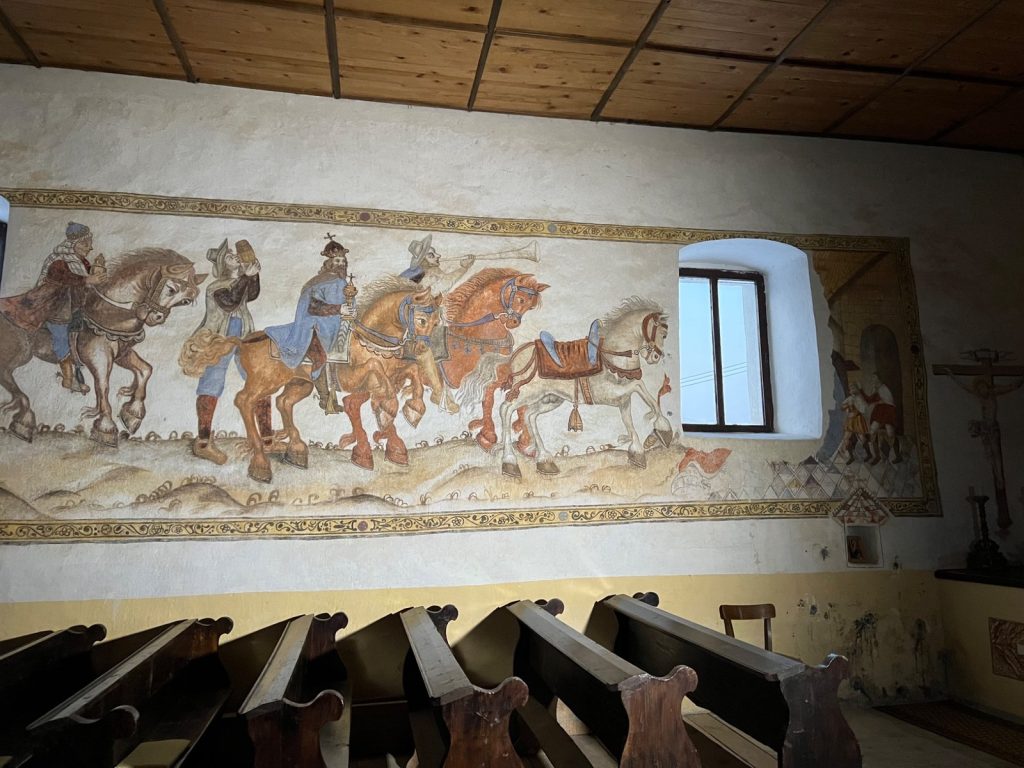
The Church of the Three Wise Men in Črni Potok is one of the few churches in the Kočevje (Gottschee) region that survived the Second World War and the devastation that followed. Its origins date back to the early 16th century, placing it among the oldest sacred buildings in the area. Inside, it preserves a valuable treasure: the fresco The Visit and Adoration of the Three Wise Men, discovered during restoration works in 1992.
Special Feature: The Thirsty Man
The Wise Men are accompanied by a Gottscheer man who, thirsty, drinks from a small barrel known as a putscherle. This small but remarkable detail reveals to visitors a glimpse of everyday life in the Kočevje region centuries ago. Putscherles were produced by the Gottscheers and sold in neighbouring regions and countries. Their importance is further attested by the fact that the renowned polymath Johann Weikhard Valvasor depicted the Gottscheers with putscherles in his extensive work The Glory of the Duchy of Carniola (1689).

Other Church Furnishings
The Church of the Three Wise Men stands in the centre of the village of Črni Potok (German: Schwarzenbach), which is listed in the register of cultural heritage as settlement heritage due to its well-preserved village core. The church rises on a small elevation in the middle of the village. Remnants of the former village cemetery wall recall the old cemetery, which was relocated in 1836 to nearby Zajčje Polje (German: Hasenfeld, Gottscheerish: Huəshnbold).
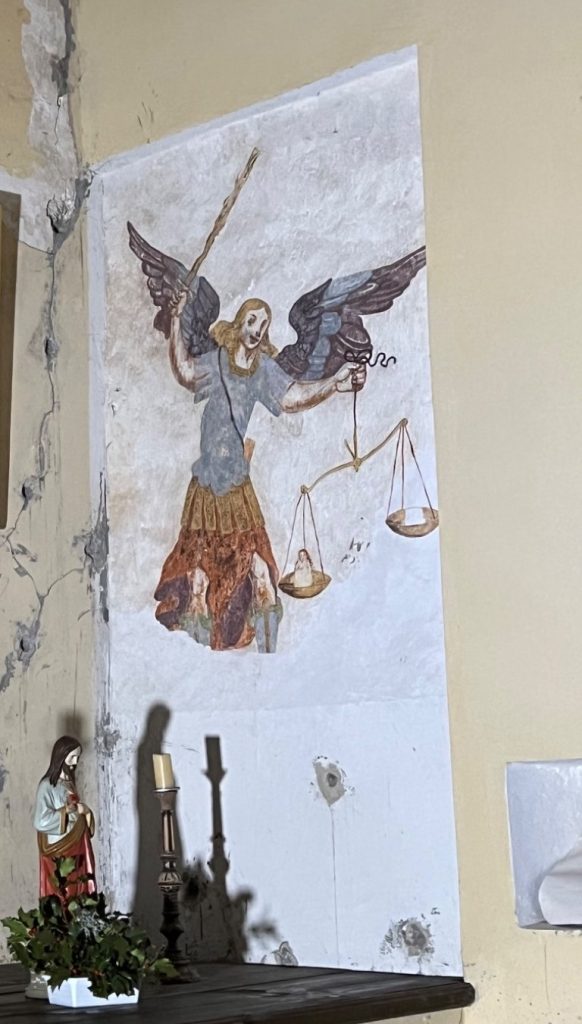
In addition to the main fresco, the church contains other exceptionally well-preserved furnishings. Among these are smaller wall paintings of the Crucified Christ and St. Michael weighing souls on a scale, as well as a late-17th-century altar, which also depicts the Adoration of the Three Wise Men.
Above the clock mechanism in the bell tower hang two iron bells dating from 1923; the smaller one is a donation from the Eisenzopf family from America.
Threats to the Church Due to Structural Damage
Today, the church is unfortunately in very poor condition. Ground subsidence and earthquake damage have caused deep cracks in the structure, threatening both the building itself and the valuable frescoes. Without timely and appropriate measures, there is a serious risk that an important part of the historical and cultural heritage will be lost.
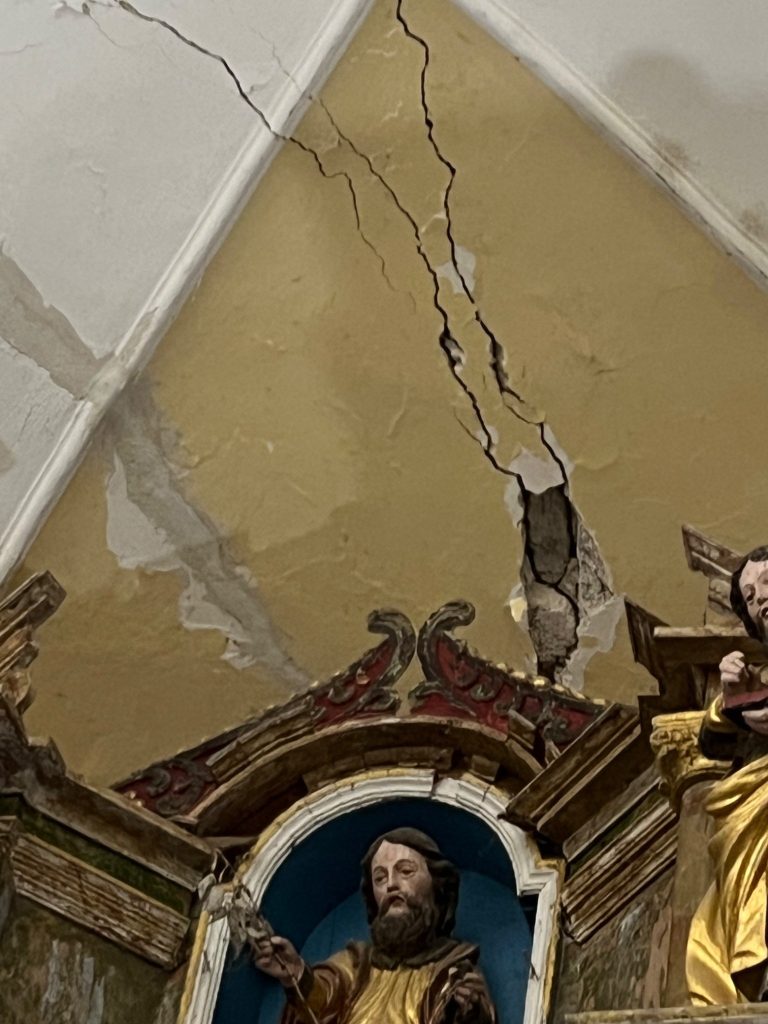
Since 2023, the Putscherle Institute has been working to protect and restore this cultural monument. A significant step forward was made at the beginning of 2025, when the Municipality of Kočevje allocated initial funds for professional analyses. These will precisely determine the necessary restoration measures – but it is already clear that the renovation will be extensive and financially demanding, and we will therefore be grateful for any donation.

The church in Črni Potok is not merely an architectural remnant. It is a bearer of local identity, a silent narrator of regional history, and a symbol of cultural coexistence in the Kočevje region. Preserving such places means preserving memory – and also creates opportunities for the development of cultural tourism in the region. Treh kraljev v Črnem Potoku ni le arhitekturni ostanek. Je nosilka identitete prostora, tiha pripovedovalka lokalne zgodovine in simbol sobivanja kultur na Kočevskem. Ohranitev takšnih krajev pomeni ohranitev spomina – pa tudi priložnost za razvoj kulturnega turizma na Kočevskem.
Sources:
Resman, Blaž in Helena Seražin. 2010. Upravna enota Kočevje: umetnostna topografija Kočevske. Ljubljana: Založba ZRC.
Zupan, Gojko, Ferenc, Mitja in France Dolinar. 1993. Cerkve na Kočevskem nekoč in danes. Kočevje: Župnija, Muzej.
V prejšnji objavi preberite: Turški vpadi: odsev v kočevarskem izročilu


No Comments Found